Jewish Genealogical Society of Montreal
|
|
Jewish Genealogical Society of Montreal
Getting Started with Jewish Genealogy |
If you are unfamiliar with modern genealogical/family-tree research, the amount of information can be overwhelming. But you don't need to learn much to be able to answer questions that you may have had for years. And you don't have to spend a lot of money or time. There are local genealogical societies than can help guide you get started. The Jewish Genealogical Society of Montreal (JGS-Montreal) was created to help people like you find out about their family trees. We have free monthly workshops that are especially oriented to new researchers and to researchers who are stuck on a problem.
This page is not a "how to" guide. It is meant to get you motivated and organized, and it will point you to a few resources. By the time you are done skimming it, you should have a better idea about what you want to do and how to do it. You might find these tips on starting a project to research your family's history useful.
There are many resources like genealogical societies and online databases with all sorts of information that you may find interesting. Before you look into any, take some time to document (1) what you know and (2) what you want to know.
There are many nicely formatted sheets for documenting what you know, but a single sheet of paper might be all you need to get started. Many researchers use software on their computers or on the web, but a single sheet of paper might be all you need to get started.
For example, here is a record of a 1901 marriage in Montreal (click it to see it full-sized):
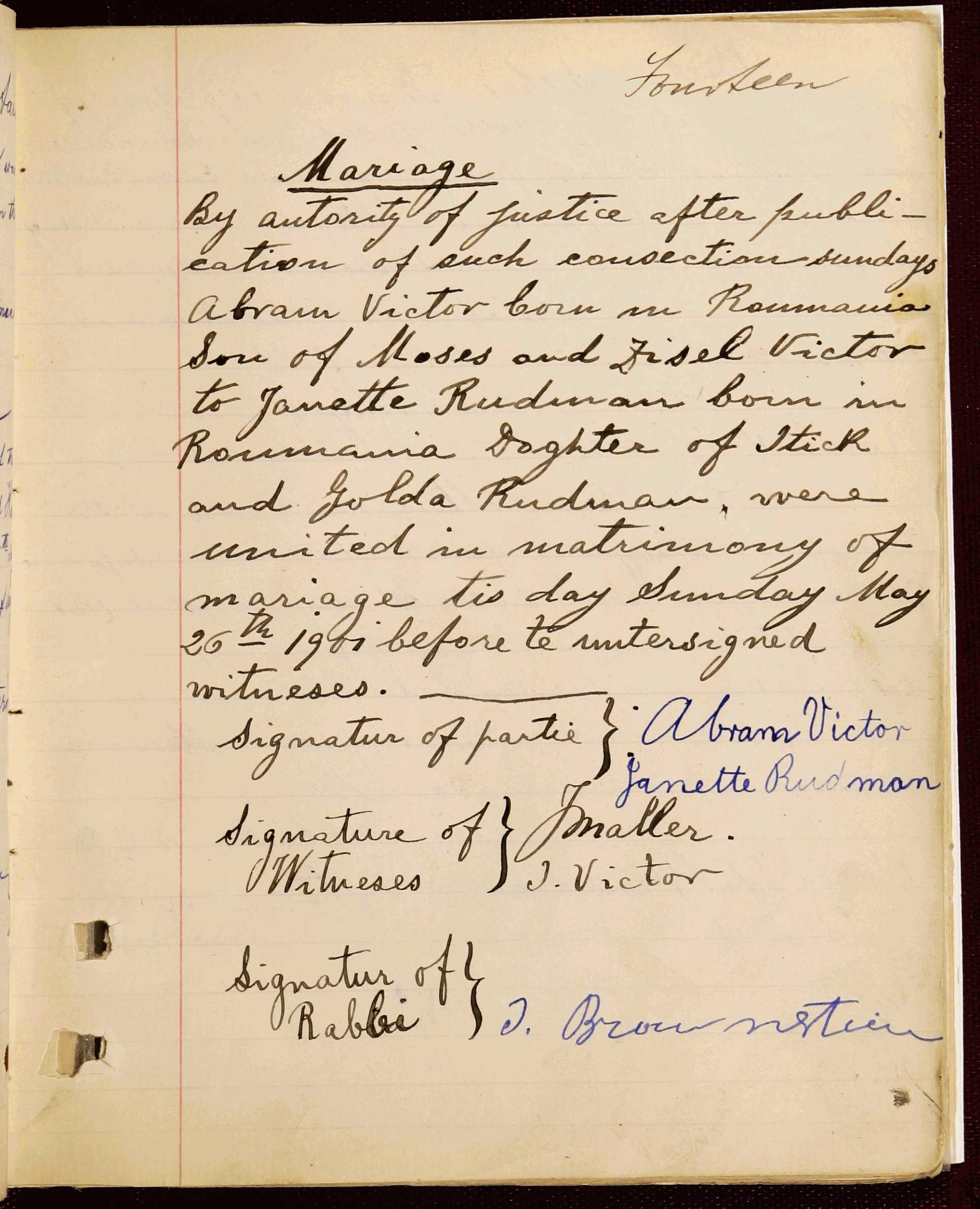 This marriage record, written by an official at the Beth David Synagogue,
is full of interesting information:
This marriage record, written by an official at the Beth David Synagogue,
is full of interesting information:
You've seen a shul's record of a 1901 marriage. The following should give you an idea of some of the kinds of records that are available. Note that these are focused on Jewish Montreal, but there are comparable documents for other religions and places. Each type of document can come from several different sources, and each can contain different types of information. Click the tiny image to see the full-sized document.
 Civil records of marriages
are filed with the province.
Depending on the date of the marriage, they can have birth dates and places of the parties,
names, birth dates and places of the parents,
information on previous marriages.
Civil records of marriages
are filed with the province.
Depending on the date of the marriage, they can have birth dates and places of the parties,
names, birth dates and places of the parents,
information on previous marriages.
 Newspaper announcements of marriages (also birth and death).
Although wedding announcements may seem to be focused on
what people were wearing and what flowers were on display,
there is often information about relatives who came from out of town.
This announcement is from the
Canadian Jewish Review.
Newspaper announcements of marriages (also birth and death).
Although wedding announcements may seem to be focused on
what people were wearing and what flowers were on display,
there is often information about relatives who came from out of town.
This announcement is from the
Canadian Jewish Review.
 Gravestones are a source of information about birth and death dates (and sometimes places),
but they also usually indicate the roles of a person in their family (e.g., mother, grandmother, great-grandmother).
Jewish gravestones usually include a person's Hebrew name,
which includes the name of the father
(or mother on some Sephardic stones, or both on some modern stones).
About half of the Montreal-area Jewish burials have been photographed,
and the records are freely available online.
Gravestones are a source of information about birth and death dates (and sometimes places),
but they also usually indicate the roles of a person in their family (e.g., mother, grandmother, great-grandmother).
Jewish gravestones usually include a person's Hebrew name,
which includes the name of the father
(or mother on some Sephardic stones, or both on some modern stones).
About half of the Montreal-area Jewish burials have been photographed,
and the records are freely available online.
 Immigration information can be found in a variety of sources,
including passenger lists, departure and landing records,
and both can often be found in naturalization files.
Immigration records for individuals often provide information about family members.
Immigration information can be found in a variety of sources,
including passenger lists, departure and landing records,
and both can often be found in naturalization files.
Immigration records for individuals often provide information about family members.
 Naturalization is the act of becoming a citizen.
Naturalization files typically contain a petition
(with all the information you'd expect a government to want to know),
immigration records, a hand-written oath of allegiance, and even an
R.C.M.P. report.
All the correspondence related to a naturalization is added to the file,
so if someone naturalized in 1927 but applied for a miniature certificate
in 1970, then that application, usually with a photograph, will also be in the file.
Naturalization files can be requested for $5 each.
Naturalization is the act of becoming a citizen.
Naturalization files typically contain a petition
(with all the information you'd expect a government to want to know),
immigration records, a hand-written oath of allegiance, and even an
R.C.M.P. report.
All the correspondence related to a naturalization is added to the file,
so if someone naturalized in 1927 but applied for a miniature certificate
in 1970, then that application, usually with a photograph, will also be in the file.
Naturalization files can be requested for $5 each.
 Census records are public in Canada 90 years after they took place,
so the most recent census data available is from 1921.
Census data is freely available from several online resources.
The information recorded in a census varies,
but it typically has the names of all people living at a location,
their relation to the head of household, their age and/or birth date,
their province or country of birth,
the year of immigration and naturalization,
their religion, what language(s) they speak,
their occupation, wages, and more.
Census records are public in Canada 90 years after they took place,
so the most recent census data available is from 1921.
Census data is freely available from several online resources.
The information recorded in a census varies,
but it typically has the names of all people living at a location,
their relation to the head of household, their age and/or birth date,
their province or country of birth,
the year of immigration and naturalization,
their religion, what language(s) they speak,
their occupation, wages, and more.
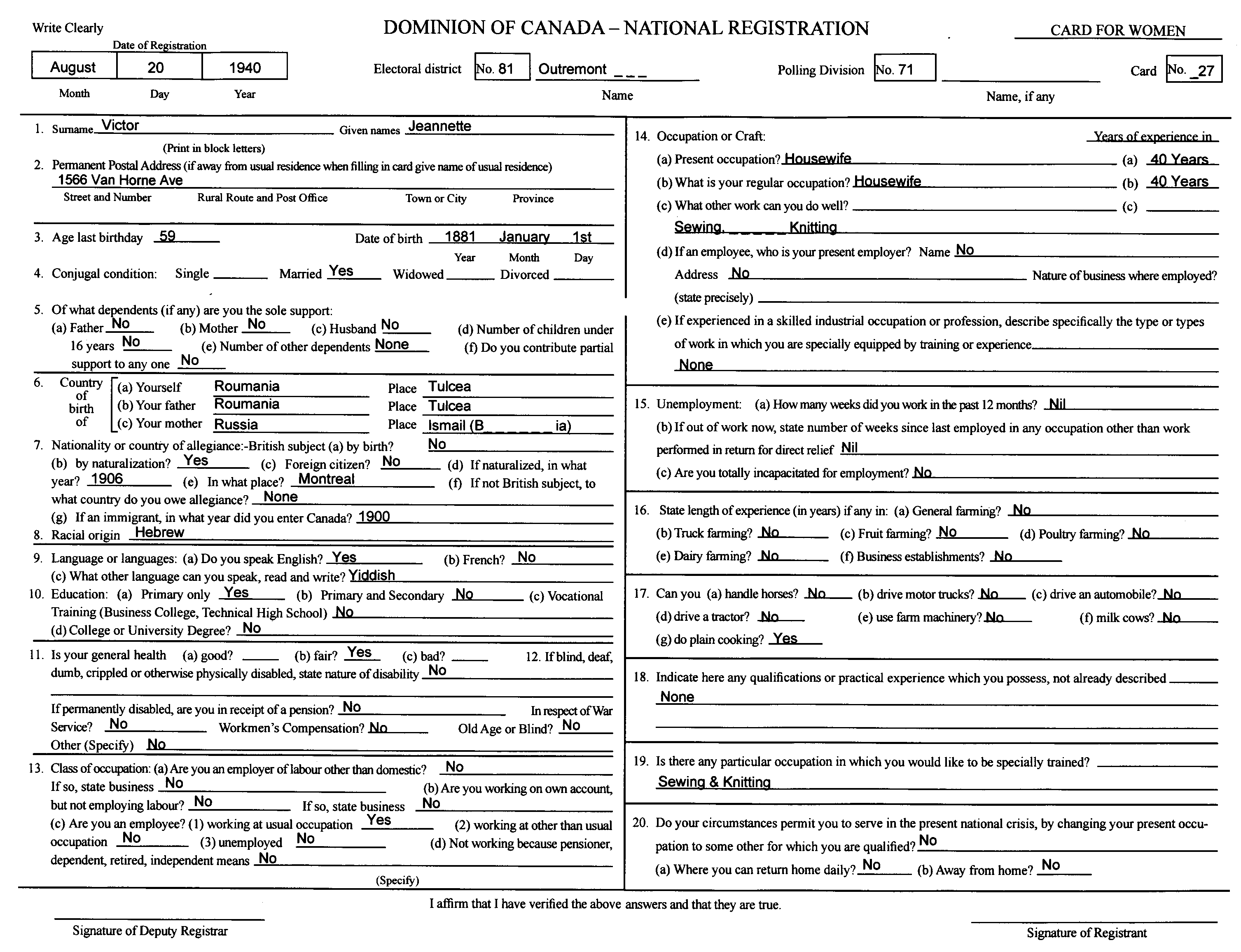 There was a special "census" in Canada related to the WWII effort.
The 1940 National Registration was required of every person, 16 and over,
and is not covered by the same privacy restrictions as the census,
so those records are not sealed.
In addition to birth date and place of the respondent,
it also indicated the birth place of their parents.
Because they cost about $50 each, they might be a last resort.
To request a 1940 National Registration,
you need the person's address, and to assist with that,
the Lovell's Directory is freely available online.
There was a special "census" in Canada related to the WWII effort.
The 1940 National Registration was required of every person, 16 and over,
and is not covered by the same privacy restrictions as the census,
so those records are not sealed.
In addition to birth date and place of the respondent,
it also indicated the birth place of their parents.
Because they cost about $50 each, they might be a last resort.
To request a 1940 National Registration,
you need the person's address, and to assist with that,
the Lovell's Directory is freely available online.
Genealogy research involves many searches (in many places for many people). The JGS-Montreal Genealogy Dashboard gathers dozens of sources in one place, and makes it easier to search those sources for each person of interest. After you fill in a name at the top, dozens of forms are filled in the rest of the dashboard. There are sections of the dashboard for census, naturalization, Quebec/Montreal, Death/Burial, Jewish, general, societies, and family trees.
For example, here is a link to research Jeannette Rudman Victor:
jgs-montreal.org/dash.
The last search form in Death/Burial Searches
matches 3 records in JOWBR, a free-access database (may require registration) of over three million Jewish burials:
Jeannette's, her husband Abram's, and her daughter Gertrude 'Gertie'.
 Jeannette's detailed record displays her footstone,
but there is a link to (a lot)
more information from JGS-Montreal.org.
There is a link to her profile on Geni.com,
which has a family tree of over 1000 profiles, including over 400 blood relatives and
over 100 descendants.
Jeannette's detailed record displays her footstone,
but there is a link to (a lot)
more information from JGS-Montreal.org.
There is a link to her profile on Geni.com,
which has a family tree of over 1000 profiles, including over 400 blood relatives and
over 100 descendants.
Back on the Genealogy Dashboard, there are dozens of searches ready to go.
Write down (1) what you know and (2) what you want to know. Then, contact us at "info" at JGS-Montreal.org, or come to one of our free Sunday morning Family Tree Workshops.